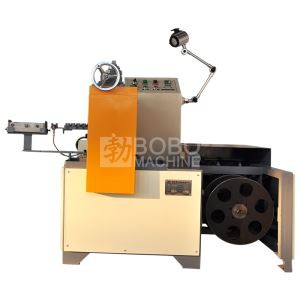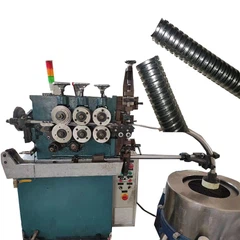


The hydraulic bellows forming machine is composed of a mandrel, a pair of push dies and a pair of dies, and the cross-sectional shape of their working parts varies according to the cross-sectional shape of the bellows. The material should be medium carbon steel or ordinary alloy steel. The requirements for strength, hardness and toughness can be the same as the general mold design standards. However, the determination of the geometric dimensions and geometric tolerances of each part of the mold must be based on the maturity obtained through long-term practice. Consider from experience.
(1) No cylindricity and different axial degrees
For bellows with a diameter of less than 150 mm or various equivalent cross-sections and different waveforms, small and medium-sized bellows, the different axial degrees of the central working part of the push mold cannot be greater than 0.03-0.05 mm, and the non-cylindricity cannot be greater than 0.05-0.08 mm . Especially for bellows molds with rectangular cross section, the requirements are even higher. Otherwise, when the mold is closed, the pipe blank may be bitten to make it leak, and as a result, the corrugation will not be formed due to the pressure loss. Even if the tube has not been bitten (only bitten), the wall thickness of this part will become thinner when the bellows forming machine is forming. In this way, it will inevitably affect its service life. For a corrugated pipe with a rectangular cross-section, the corrugation thickness and trough width on the four surfaces may be uneven, or the depth of the corrugation may be different. Therefore, it is a basic principle in the design of bellows hydroforming molds to strictly control the tolerance of non-cylindricity and different axial degrees.
(2) cooperation
When designing the mold, of course, it cannot be converted mechanically according to the tube blank diameter and wall thickness. Corrugated pipe forming machine Due to the tolerances of the tube blank manufacturing tolerance of the thin wall of the tube and the characteristics of the single-wave continuous forming process, according to the different cross-sectional size of the corrugated tube, the push mold, die and the outer surface of the tube blank should be statically matched or equivalent to the static The state of transitional cooperation. There is no gap between them. In order to ensure no leakage during the molding process, the outer diameter of the sealing ring is larger than the outer diameter of the mandrel, so that the actual support of the tube blank sleeved on the mandrel is the sealing ring, not the mandrel itself.
(3) Determination of the fillet value
On the mold of the bellows forming machine, the R value of each part has its various functions. The size of the R value directly affects the forming quality of the bellows. Due to the different materials and specifications, the amount of springback after the corrugation is different. Whether the R value is properly determined is directly related to whether a qualified product can be produced. Therefore, carefully analyzing the actual meaning of each R value is also an aspect that cannot be ignored in the design of bellows hydroforming molds.