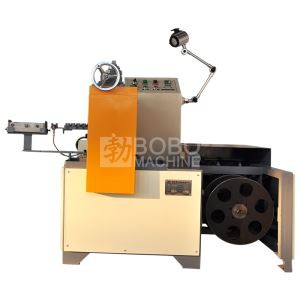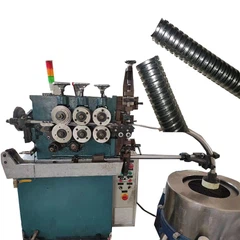


CNC metal hose machine is mainly used for winding round steel wire, flat steel wire and other objects into tubes. It is a structural diagram of a typical CNC aluminum foil hose machine in the prior art. During the production process, the motor 1'1 drives the main shaft to rotate around the synchronous wheel through the synchronous belt 1'6, and then drives the motor head 1'4 to rotate; at the same time, the motor also drives the driving shafts 1 and 2 to rotate around the other through the synchronous belts 1 and 8. The synchronous wheel rotates, and the active shafts 1 and 2 drive the passive shafts 1 and 9 to rotate through the manual speed regulating mechanisms 1 and 3 and the passive shaft 1'9. The intermediate shaft is driven to rotate by the synchronous belt 1'7, and then the pressing wheel 1'5 is driven to rotate by the intermediate shaft, the main shaft and the intermediate shaft cooperate with each other, and finally the processed parts are processed into tubes.
In order to ensure the quality of the workpiece, there must be a fixed transmission ratio between the main shaft and the counter shaft. However, in actual use, due to mechanical governor and machine failure, the speed ratio of the main shaft speed and the counter shaft speed will be unstable, resulting in unqualified products. In addition, the shape error and hardness error of the processed materials, as well as the changes caused by the continuous wear of the press wheel and the countershaft driving mold, will also cause the deviation of the countershaft speed, which will result in unqualified products.
Therefore, it is necessary to adjust the rotation speed of the countershaft. In the prior art, it is generally realized by the hose machine manufacturer by adjusting the manual speed regulating mechanism. When the speed of the secondary shaft of the CNC metal hose machine exceeds the allowable speed ratio range, the operator adjusts the handwheel 1'33 of the manual speed regulating mechanism 1'3, drives the speed regulating shaft 1'32 to rotate, and changes the continuously variable transmission 1' 31 gear ratio; then change the speed of the output shaft of the continuously variable transmission 1'31 to achieve the purpose of speed regulation. Generally speaking, only when defective products or even waste products appear, the staff can find that changing the speed of the countershaft by adjusting the hand wheel can reduce the pass rate of the processed parts, and it also requires some work experience. The operator can only operate a limited number of machines at the same time, which not only causes a lot of waste of manpower and material resources, but also the low product qualification rate, which seriously affects the production speed of the product. Therefore, how to control the rotation speed of the countershaft within an appropriate range at any time, and how to improve the pass rate and production speed of processed products are technical problems that need to be solved by those skilled in the art.